
If you’ve started collecting quotes for a rooftop solar system, you’ve probably already noticed the problem: prices swing wildly from one installer to the next, and it’s hard to tell what’s actually driving the difference. Understanding rooftop solar panel cost in India isn’t just about a single number — it depends on your system size, the panel technology used, the inverter, your roof condition, your location, and whether you qualify for a subsidy.
This guide walks through what a rooftop solar system actually costs in 2026, what goes into that cost, how pricing changes across common system sizes, and how to evaluate a quotation properly before you sign anything.
Rooftop Solar Panel Cost in India in 2026
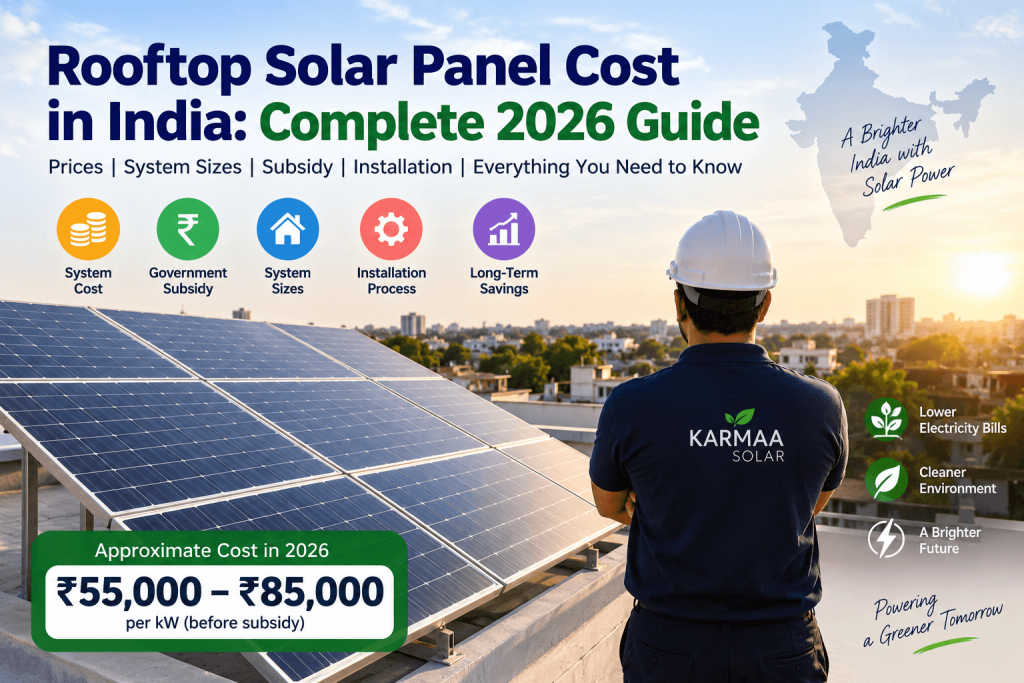
As a general starting point, a complete installed rooftop solar system in India costs approximately ₹55,000 to ₹85,000 per kW in 2026, before any government subsidy is applied. This range covers panels, inverter, mounting structure, cabling, protection equipment, and installation labour.
This is a broad range, and for good reason. The actual price you’re quoted will depend on:
- System capacity — larger systems generally cost less per kW
- Panel technology — polycrystalline, monocrystalline PERC, or newer TOPCon/bifacial panels are priced differently
- Inverter type — string, hybrid, or micro-inverters vary in cost
- Mounting structure — flat RCC roofs are cheaper to work with than sloped or tin-sheet roofs
- Installation complexity — roof height, shading, and cable routing all affect labour cost
- Location — transportation and labour costs differ by city and state
- System type — on-grid, off-grid, or hybrid systems have very different cost structures
- Applicable subsidy — central and, in some states, additional state-level incentives reduce your net cost
Here’s an approximate cost overview by system size, before subsidy:
| Solar System Size | Approximate System Cost | Suitable For |
|---|---|---|
| 1 kW | ₹65,000 – ₹85,000 | Very small households, single-appliance backup |
| 2 kW | ₹1.1 lakh – ₹1.5 lakh | Small households with moderate usage |
| 3 kW | ₹1.5 lakh – ₹2.1 lakh | Average household (AC, fridge, standard appliances) |
| 5 kW | ₹2.5 lakh – ₹3.5 lakh | Larger homes, small shops, or offices |
| 10 kW | ₹5 lakh – ₹7.5 lakh | Bigger homes, small commercial establishments |
These figures are indicative ranges based on typical 2026 market pricing and will vary by installer, brand, and site conditions. Always treat a formal, itemised quotation from a site assessment as the accurate figure for your property.
What Is Included in a Rooftop Solar System Cost?
A complete rooftop solar system cost isn’t just the price of the panels. A proper installation includes several components working together:
- Solar panels — typically 40–50% of the total system cost
- Solar inverter — converts DC power from panels into usable AC power
- Mounting structure — holds panels securely on your roof, engineered for local wind loads
- DC and AC cables — connect panels to the inverter and the inverter to your electrical panel
- Protection equipment — surge protectors, fuses, and isolators that safeguard the system
- Earthing system — required for safety and electrical compliance
- Installation and commissioning — the physical work of mounting, wiring, and testing the system
- Monitoring system — where applicable, lets you track generation via an app or dashboard
- Other balance-of-system components — junction boxes, conduits, and miscellaneous hardware
A common mistake is comparing quotes that only list the panel price without confirming whether these other components are included.
3kW Solar Panel Price and Complete System Cost
A 3kW system is the most commonly installed rooftop solar system size for Indian households, and it’s also the point where the search intent around “3kW solar panel price” tends to be strongest.
Who typically needs a 3kW system? Households with a monthly electricity bill in the range of roughly ₹2,000–₹4,000, running standard appliances such as a refrigerator, a few fans, lighting, and possibly one air conditioner, often find a 3kW system suitable. Actual sizing should be based on your last few months of electricity bills, not a rough guess.
Panel-only price vs. complete system price It’s important to separate the two. The panel-only price refers to just the modules — often quoted per watt. The complete installed system price includes the inverter, mounting, cabling, protection equipment, and labour, and this is the figure that actually matters when comparing quotes.
What affects the 3kW price Panel brand and technology, inverter type (string vs hybrid), roof type, and whether structural reinforcement is needed all move the final number within the ₹1.5–2.1 lakh range mentioned above.
Potential savings A well-sized 3kW system can meaningfully offset a household’s daytime electricity consumption, though the actual bill reduction depends on your consumption pattern, local tariff structure, and how much power you self-consume versus export to the grid.
5kW Solar System Cost in India
A 5kW rooftop solar system suits larger households or small commercial spaces with higher daytime electricity usage — typically homes running two air conditioners, or small offices and shops.
Components and pricing The same components apply as with smaller systems, but at 5kW, some installers offer marginally better per-kW pricing due to economies of scale on labour and mobilisation. Expect the complete installed cost to fall roughly between ₹2.5 lakh and ₹3.5 lakh before subsidy.
Expected generation Actual generation depends on your location’s solar irradiation, panel orientation, shading, and system efficiency, so it’s best understood as a range rather than a fixed daily number — your installer should be able to give you a site-specific generation estimate after assessment.
Payback considerations Because subsidy support is capped at a certain system size (more on this below), a 5kW system generally has a longer payback period than a 3kW system in absolute terms, even though the total savings over its lifetime can be higher for a household that genuinely needs that much capacity.
10kW Rooftop Solar System Cost
A 10kW system is typically suited to larger homes with significant electricity consumption, or small commercial and light-industrial establishments looking to offset a meaningful share of their grid electricity usage.
At this scale, cost per kW is usually the lowest among common residential/small-commercial sizes, but the total investment — approximately ₹5 lakh to ₹7.5 lakh before subsidy — is naturally higher. At 10kW and above, it becomes especially important to have a professional load and roof assessment done, since structural capacity, available shadow-free roof area, and sanctioned electrical load from your DISCOM all become limiting factors.
On-Grid vs Off-Grid vs Hybrid Solar System Cost
The type of system you choose has a significant effect on overall cost, mainly because of whether a battery is involved.
| System Type | Battery Required? | Typical Use | Cost Level | Main Advantage |
|---|---|---|---|---|
| On-Grid | No | Homes/businesses with reliable grid connection | Lowest | Lower cost, net metering benefits |
| Off-Grid | Yes | Areas with no or unreliable grid access | Highest | Full independence from grid |
| Hybrid | Yes (usually smaller) | Homes wanting backup during outages | Moderate to high | Grid savings plus power backup |
On-grid systems are the most common and most affordable choice for urban and semi-urban homes, since they don’t require batteries and can export surplus power to the grid under net metering arrangements (where available).
Off-grid systems are designed for locations without dependable grid access. Because they rely entirely on battery storage, they cost considerably more per kW than on-grid systems.
Hybrid systems sit in between — they stay connected to the grid but include a battery for backup during outages. This added battery capacity increases upfront cost compared to a pure on-grid system, but offers continuity of power supply that on-grid systems can’t provide during a grid outage.
What Factors Affect Rooftop Solar Panel Cost?
Beyond system size and type, several variables influence the final price you’re quoted:
- Panel type and efficiency — higher-efficiency panels (like TOPCon) cost more per watt but need less roof area
- Inverter type — hybrid and micro-inverters cost more than standard string inverters
- Battery requirement — adds significantly to cost for off-grid or hybrid setups
- Roof type — RCC flat roofs are generally cheaper to install on than sloped, tiled, or metal-sheet roofs
- Installation complexity — roof height, obstructions, and shading affect labour time and design
- Location — logistics and labour costs vary by city and state
- Electrical upgrades — older homes may need panel or wiring upgrades to safely support a solar connection
- Mounting structure — custom structures for unusual roof shapes add cost
- Brand and warranty — established manufacturers with longer warranties typically price higher than lesser-known brands
- Government incentives — subsidy eligibility can substantially reduce your effective out-of-pocket cost
Government Solar Subsidy in India
The Indian government offers subsidy support for residential rooftop solar installations under central schemes, and in some states, additional local incentives are available on top of the central subsidy.
Rather than quoting a specific rupee figure here — subsidy slabs and eligibility criteria are periodically revised, and the amount you qualify for depends on your system size, whether your installer is empanelled with the relevant authority, and your state’s specific policy — it’s more useful to understand the structure:
Gross system price (before any subsidy) minus applicable central and/or state subsidy equals your effective net cost
Only installers empanelled under the applicable subsidy scheme can process subsidy claims on your behalf, so it’s worth confirming this before finalising a quote. For the most current subsidy amounts and eligibility criteria, check with your installer or your state’s renewable energy department at the time of purchase, since these figures are revised periodically.
Solar Installation Cost: What Does Installation Include?
Installation cost — as opposed to equipment cost — generally covers:
- Site survey and structural assessment
- System design and engineering
- Mounting structure fabrication and fixing
- Panel installation and wiring
- Inverter installation and configuration
- Earthing and lightning protection setup
- Testing and commissioning
- Liaison for net metering approval, where offered by the installer
Some installers bundle installation into the total system price; others break it out separately. Always ask for a clear, itemised breakdown so you know exactly what you’re paying for and what, if anything, is being charged as an extra.
How Much Can a Rooftop Solar System Save on Electricity Bills?
Savings from a rooftop solar system depend on multiple factors working together, and no installer can honestly promise a fixed savings percentage without understanding your specific situation:
- Your electricity consumption pattern — how much power you use, and when
- System capacity — how much of your load the system is sized to offset
- Local solar irradiation — sunlight availability varies by region and season
- Electricity tariff — savings are more significant where grid tariffs are higher
- Self-consumption vs export — power you use directly as it’s generated typically offers better value than power exported under net metering, depending on your DISCOM’s export rules
- System performance over time — panel output gradually declines over its operational life, and shading, dust, or poor maintenance can reduce actual generation
A proper savings estimate should come from an installer reviewing your actual electricity bills and roof conditions, not a generic percentage figure.
Solar Payback Period in India
Payback period is the time it takes for your electricity savings to equal your net investment. It’s calculated as:
Payback Period = Net Solar Investment ÷ Annual Electricity Savings
For example (using hypothetical numbers purely to illustrate the formula, not as a real-world claim):
If your net investment after subsidy is ₹1,00,000, and your system saves you ₹25,000 a year in electricity costs, your payback period would be:
₹1,00,000 ÷ ₹25,000 = 4 years
Your actual payback period will depend on your real investment amount, your actual annual savings, and how your electricity consumption and local tariffs change over time — so treat any payback figure you’re given as an estimate rather than a guarantee.
How to Choose the Right Rooftop Solar System Size
The most reliable way to size a system is to look at your recent electricity bills, not your roof size or a round number that “sounds right.”
- 1kW–2kW — suitable for very small households or specific backup needs, usually not enough to meaningfully offset a full household’s consumption
- 3kW — a common fit for average households with moderate daytime usage
- 5kW — suited to larger homes, homes with multiple ACs, or small commercial spaces
- 10kW and above — appropriate for bigger homes, shops, offices, or light-industrial use with higher and more consistent daytime load
A proper site assessment — reviewing your bills, roof area, shading, and sanctioned electrical load — is the only reliable way to confirm the right size for your property. Choosing a system based purely on available roof space, without checking actual consumption, often leads to an oversized or undersized system.
How to Compare Solar Quotes From Different Installers
Use this checklist when comparing quotations, since price alone doesn’t tell the full story:
- Panel brand and model
- Panel wattage and technology
- Number of panels included
- Inverter brand, model, and capacity
- Mounting structure specifications
- Protection equipment included
- Earthing provisions
- Installation and commissioning scope
- Warranty terms (panels, inverter, and workmanship separately)
- Monitoring system, if included
- Subsidy application assistance
- Net-metering application assistance
- Applicable taxes
- Any additional or hidden charges
Two quotes with the same headline number can represent very different systems once you check these details.
Common Mistakes to Avoid When Buying Rooftop Solar
- Choosing purely on lowest price without checking what’s actually included
- Ignoring inverter quality — a weak inverter can bottleneck an otherwise good panel setup
- Not checking warranty terms for panels, inverter, and installation workmanship separately
- Not understanding what’s included in the quoted price versus what will be billed as an extra
- Choosing the wrong system capacity — either oversized for actual need or too small to meet consumption
- Ignoring roof condition — an ageing or weak roof may need repair or reinforcement before installation
- Assuming guaranteed savings — actual savings depend on your consumption, tariffs, and system performance
- Not comparing complete quotations side by side using the same checklist
Is Rooftop Solar Worth the Cost in 2026?
Rooftop solar can be a sound long-term investment for many Indian homeowners and businesses, but whether it’s worth it for you specifically depends on your situation.
On the positive side, a well-sized system can meaningfully reduce electricity bills over its operational life, offer a degree of energy independence, and — where subsidy support applies — bring down the effective upfront cost. Solar panels also require relatively low maintenance compared to many other home investments.
On the other hand, the upfront investment is real, payback periods vary based on your consumption and local tariffs, and results depend heavily on getting the system size, equipment quality, and installation right. Roof suitability, shading, and your sanctioned electrical load all need proper assessment before you can expect your system to perform as designed.
The honest answer is that rooftop solar is worth it for many households and businesses, but the value depends on getting your specific numbers — consumption, roof condition, and financing — assessed properly rather than relying on generic claims.
Frequently Asked Questions
What is the rooftop solar panel cost in India in 2026?
Rooftop solar panel cost in India in 2026 is approximately ₹55,000 to ₹85,000 per kW for a complete installed system, before subsidy. The exact price depends on system size, panel technology, inverter type, and installation complexity.
How much does a 3kW rooftop solar system cost?
A 3kW rooftop solar system typically costs approximately ₹1.5 lakh to ₹2.1 lakh before subsidy, covering panels, inverter, mounting, cabling, and installation. Applicable subsidy can reduce this net cost further.
What is the cost of a 5kW solar system in India?
A 5kW solar system generally costs approximately ₹2.5 lakh to ₹3.5 lakh before subsidy. Final pricing depends on panel brand, inverter type, roof condition, and location-specific installation factors.
How much does solar panel installation cost?
Installation cost is usually bundled into the total system price and covers site assessment, mounting, wiring, earthing, and commissioning. Ask your installer for an itemised breakdown to see installation labour separately from equipment cost.
Is rooftop solar cheaper with a government subsidy?
Yes, applicable central and state subsidies reduce your effective net cost below the gross system price. Subsidy amounts and eligibility vary by system size and state, so confirm current details with an empanelled installer.
How much can a rooftop solar system reduce electricity bills? Savings depend on your consumption pattern, system size, local tariffs, and how much power you self-consume versus export. There’s no fixed guaranteed percentage — a proper estimate requires reviewing your actual electricity bills.
How many solar panels are required for a 5kW system?
The number depends on individual panel wattage. Higher-wattage panels mean fewer panels are needed to reach 5kW, while lower-wattage panels require more units and correspondingly more roof area.
Which is better: on-grid, off-grid, or hybrid solar?
On-grid systems are the most cost-effective for homes with reliable grid access. Off-grid suits areas without dependable grid connectivity. Hybrid systems add battery backup for outages at a higher cost than pure on-grid setups.
How long does a rooftop solar system last?
Solar panels typically carry performance warranties extending over multiple decades, though actual operational life and output depend on installation quality, maintenance, and environmental conditions. Inverters generally have shorter warranty periods than panels and may need replacement sooner.
How long does it take to recover the solar investment?
Payback period is calculated as net investment divided by annual electricity savings, and varies based on your actual investment, consumption, and local tariffs. There’s no single fixed number that applies to every household.
What maintenance does a rooftop solar system require?
Rooftop solar systems generally need periodic cleaning to remove dust buildup and occasional inspection to check wiring, connections, and inverter performance. Maintenance needs are relatively low compared to many other home systems, but not zero.
How do I choose the right solar system size? Base your system size on your recent electricity bills and actual consumption pattern rather than your available roof space. A professional site assessment covering your usage, roof condition, and sanctioned load gives the most accurate sizing.
Get a Personalised Rooftop Solar Quote
Rooftop solar panel cost varies enough from one property to another that generic figures can only take you so far. If you’re evaluating whether rooftop solar makes sense for your home or business, the next practical step is a proper site assessment — reviewing your electricity bills, roof condition, and available space to arrive at an accurate system size and price.
Karma Solar offers rooftop solar installation services for residential, commercial, and industrial properties, along with energy storage solutions for those considering battery backup. If you’d like a consultation, site assessment, and a clear, itemised quotation for your property, contact our solar experts to get started.