
If your electricity bill keeps climbing every summer and you’ve been hearing about “free solar” from the government, you’re not imagining things. The PM Surya Ghar Yojana 2026 is real, it’s active, and lakhs of Indian households have already used it to cut their power bills to zero. But most people still don’t know exactly how much subsidy they qualify for, who’s eligible, or how the application actually works.
This guide breaks down everything about the PM Surya Ghar subsidy – eligibility, amount, documents, application steps, and the mistakes that get applications rejected in plain language. By the end, you’ll know exactly what to do next.
What is PM Surya Ghar Yojana 2026?
PM Surya Ghar Muft Bijli Yojana was launched by the central government with one simple goal: put rooftop solar on one crore Indian homes and bring monthly electricity bills down to zero for participating households. It’s backed by a total outlay of over ₹75,000 crore, making it the largest residential rooftop solar subsidy programme the country has ever run.
Here’s the basic idea behind PM Surya Ghar Yojana 2026: you install a solar system on your roof, the government pays a chunk of the cost directly into your bank account, and going forward, the electricity your panels generate is free – you only pay for whatever extra you pull from the grid. Many households that size their system correctly end up with a bill of ₹0, or close to it, every single month.
Since its launch, the scheme has crossed 65 lakh applications nationwide, with the pace of installations rising from roughly 7,000 a month before the scheme to well over three lakh installations every month now. Gujarat, in particular, has been one of the top-performing states — it already leads the country in the number of rooftop installations completed and subsidy disbursed under this scheme, which is good news if you live in Vadodara, Ahmedabad, or anywhere else in the state.
PM Surya Ghar Subsidy Amount 2026 — How Much Will You Actually Get?
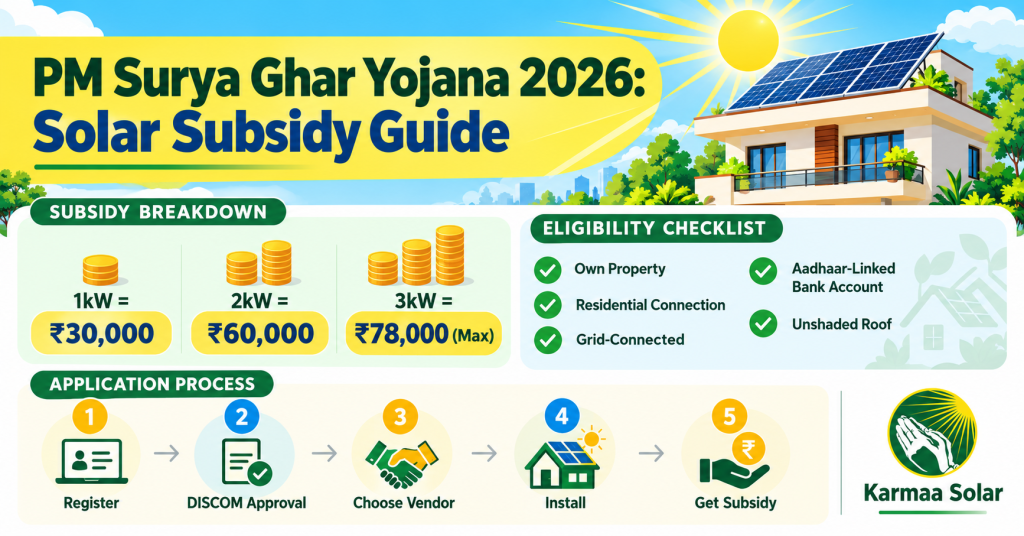
This is usually the first question people ask, so let’s get straight to numbers. The solar subsidy 2026 slabs under this scheme are based on your system size:
| System Size | Subsidy Rate | Maximum Subsidy |
|---|---|---|
| 1 kW | ₹30,000 per kW | ₹30,000 |
| 2 kW | ₹30,000 per kW | ₹60,000 |
| 3 kW and above | ₹18,000 for the 3rd kW | ₹78,000 (capped) |
In simple terms: if you install a 3kW system which is the standard size for most middle-class homes with a monthly consumption of 200–300 units you can get up to ₹78,000 as central subsidy. Anything above 3kW does not get additional central subsidy, though some states add their own top-up on top of this.
This subsidy is paid as Direct Benefit Transfer (DBT), meaning it lands straight in your bank account there’s no need to visit any government office or deal with middlemen. The whole idea behind this PM Surya Ghar subsidy structure is to make the upfront cost of solar manageable, so families don’t have to pay the full price out of pocket.
Beyond the subsidy, the scheme is also designed around a bigger promise: up to 300 units of free electricity per month for households whose consumption and system size match up well. That’s the real long-term value the subsidy just lowers your entry cost.
PM Surya Ghar Eligibility — Do You Qualify?
Before you get excited about the numbers, check whether you actually meet the PM Surya Ghar eligibility conditions. The rules haven’t changed dramatically since launch, but verification has gotten stricter in 2026, so it’s worth checking each point carefully:
- You must own the property, or have the owner’s written consent. Joint ownership is fine. Tenants cannot apply directly.
- You need a residential electricity connection — the meter should be in your name or an immediate family member’s name, and it must be a domestic category connection, not commercial or industrial.
- Your connection must be grid-connected. Off-grid setups don’t qualify for this particular subsidy.
- Your roof needs unshaded space. As a rough rule, you need about 10 square metres of shadow-free roof area per kW of system you want to install.
- Your bank account must be Aadhaar-linked, and the name on the account should match your application exactly — mismatches are one of the biggest reasons DBT payments fail or get delayed.
- One subsidy per consumer number. You can only claim this once per electricity connection, and it doesn’t reset if the property is sold.
If you tick all these boxes, you’re in good shape. If you’re unsure about roof shading, load capacity, or which category your connection falls under, this is exactly the kind of site assessment a local EPC partner like Karmaa Solar handles as part of the free consultation before your application even goes in.
Documents You'll Need
Keeping these ready in advance saves a lot of back-and-forth later:
- Aadhaar card (linked to the bank account you’ll use for DBT)
- Latest electricity bill (with your consumer account number visible)
- Proof of property ownership or the owner’s no-objection consent
- Bank passbook or a cancelled cheque
- Passport-size photograph
- Mobile number registered with your DISCOM
How to Apply for PM Surya Ghar Yojana 2026 — Step by Step
The application process is entirely online through the national portal (pmsuryaghar.gov.in), and it typically looks like this:
- Register on the portal. Sign up using your state, DISCOM, and electricity consumer number, then verify your mobile number with an OTP.
- Submit your application. Enter your rooftop details and the system size you want — this gets sent to your DISCOM for technical feasibility approval.
- Wait for DISCOM approval. Your local electricity board checks whether your connection and roof can support the system. This usually takes anywhere from a week to a month, depending on your DISCOM.
- Choose an MNRE-empanelled vendor. This is where a lot of people get stuck — you can only work with a government-registered installer. This is a good point to compare quotes; a trusted local EPC company like Karmaa Solar can walk you through vendor registration, system sizing, and paperwork so nothing gets rejected on a technicality.
- Installation. Once you finalize your vendor, the system is typically installed within 1–3 weeks.
- Net meter installation. After installation, your DISCOM installs a bi-directional net meter, which tracks both the power you draw and the power you export back to the grid.
- Submit your completion report. Upload photos of the installed system, the commissioning certificate, and your bank details on the portal.
- Subsidy disbursement. Once your DISCOM inspects and approves the installation, the subsidy is credited directly to your bank account.
The government’s official target is 30 working days from commissioning to subsidy credit, though this varies a lot depending on your state’s DISCOM efficiency. Gujarat has generally been among the faster and better-performing states for this scheme, which works in favour of homeowners applying in Vadodara and nearby regions.
Common Mistakes That Delay or Reject Applications
A large share of rejections and delays under PM Surya Ghar Yojana 2026 aren’t about eligibility at all they’re simple process errors. Watch out for:
- Name mismatches between your Aadhaar, bank account, and electricity bill even small spelling differences can hold up your DBT.
- Choosing a non-empanelled vendor, which automatically disqualifies your application from subsidy eligibility.
- Incorrect system sizing going above what your sanctioned load supports, or undersizing based on your actual consumption.
- Incomplete documentation at the completion-report stage, which is the step most people rush through.
- Not following up. If your subsidy hasn’t arrived 90 days after commissioning, escalate through your DISCOM’s grievance cell first, then the MNRE helpline, rather than waiting indefinitely.
Why Work With a Local EPC Partner Like Karmaa Solar
The scheme itself is straightforward on paper, but in practice, most delays happen because of small process mistakes wrong vendor selection, incorrect system sizing, or missing documentation. This is exactly where a full-service solar EPC company earns its value.
Karmaa Solar handles rooftop solar installations end-to-end for homes and businesses across Vadodara and Indore from the initial site assessment and system design, through vendor-compliant installation, to helping customers navigate the PM Surya Ghar subsidy paperwork correctly the first time. Because the team is MNRE-aligned and has already completed 150+ solar projects, homeowners avoid the common pitfalls that cause rejected applications or delayed DBT payments.
If you’re exploring rooftop solar subsidy options this year, getting your system sized and your paperwork right from day one is what actually determines how smoothly your subsidy comes through.
Is This the Right Time to Apply?
Yes and here’s why timing matters. The scheme runs on a fixed national budget of ₹75,021 crore, and a significant portion has already been disbursed. This isn’t an entitlement that renews every year; once the 1-crore household target is met or the budget is exhausted, the window closes. Combined with the fact that solar panel prices and financing options have both improved significantly in 2026, waiting longer mostly means paying more and risking missing the subsidy altogether.
For anyone seriously considering solar subsidy India programmes, 2026 is shaping up to be one of the more favourable years to actually go ahead panel technology is better, quotes are more transparent, and the subsidy processing across most states, especially Gujarat, has become noticeably faster than it was at launch.
Conclusion
The PM Surya Ghar Yojana 2026 genuinely is one of the best opportunities Indian households have had to make solar affordable a subsidy of up to ₹78,000, a straightforward online process, and the potential for a zero electricity bill going forward. The eligibility rules are simple, the documentation is manageable, and most of the friction people run into comes down to avoidable process mistakes rather than the scheme itself.
If you’re in Vadodara, Indore, or anywhere nearby and want a straightforward, well-guided path through this from checking your roof’s feasibility to getting your subsidy application right the first time Karmaa Solar‘s team can walk you through the entire journey, free of confusion and free of guesswork.
Frequently Asked Questions
1. How much subsidy can I get under PM Surya Ghar Yojana 2026?
You can get up to ₹78,000 for a 3kW residential rooftop solar system ₹30,000 per kW for the first 2kW, and ₹18,000 for the third kW. Systems larger than 3kW don’t receive additional central subsidy, though some states offer their own top-ups.
2. Who is eligible for the PM Surya Ghar subsidy?
Any Indian household with a residential, grid-connected electricity connection is eligible, provided you own the property (or have the owner’s consent), have unshaded roof space, and haven’t already claimed the subsidy on that consumer number before. Commercial and agricultural connections don’t qualify.
3. How long does it take to receive the solar subsidy after installation?
The official target is 30 working days from commissioning to subsidy credit, but actual timelines vary by state and DISCOM efficiency. Gujarat has generally been among the quicker states for disbursement.
4.Can I choose any solar installer for PM Surya Ghar Yojana?
No you must select an MNRE-empanelled vendor for your subsidy application to be valid. Working with an experienced, registered EPC company like Karmaa Solar ensures your vendor selection and documentation meet scheme requirements from the start.
5. What happens if my subsidy doesn't arrive on time?
If it hasn’t been credited within 90 days of commissioning, first file a complaint with your DISCOM’s consumer grievance cell, then escalate to the MNRE helpline (1800-180-3333), and finally to your state nodal agency or CPGRAMS if it’s still unresolved.